
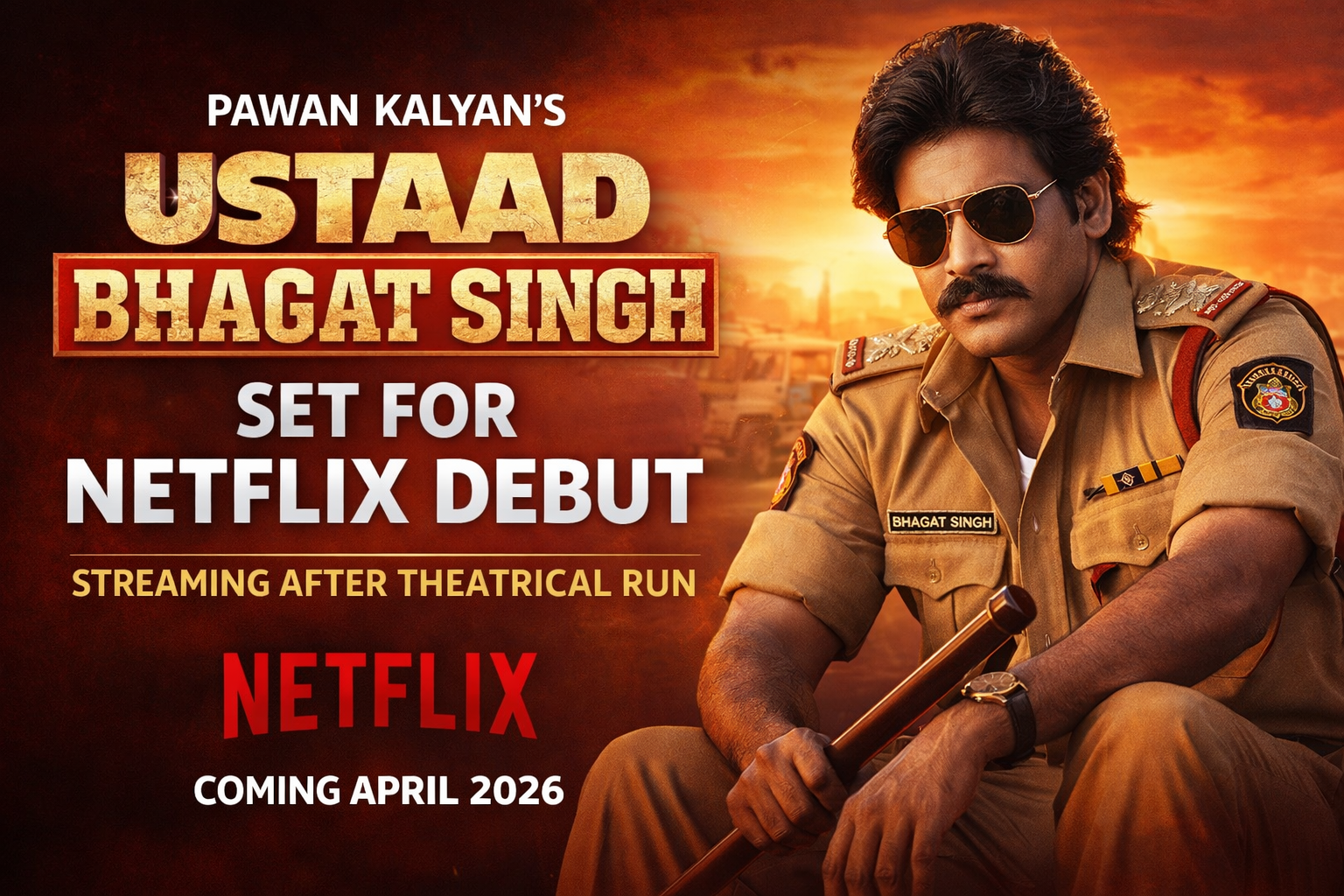
Ustaad Bhagat Singh, a Pawan Kalyan film being digitally introduced on Netflix, is one of the biggest Telugu movies to be released on Netflix after the theatrical release. The news arrives as the film continues to experience high occupancy on box office and ongoing debates about the film and its mixed critical reviews.
The action entertainer was released in theatres on March 19, 2026, during the Ugadi festival, and is the much-awaited joint venture of Pawan Kalyan and Harish Shankar, the duo that gave birth to the blockbuster Gabbar Singh.
A Tactical Theatrical and OTT Release
As per the recent news, Netflix has purchased the online streaming rights to the movie, and it is set to release it on OTT around five weeks after its premiere in theaters. This puts its projected streaming release at the end of April 2026, which coincides with the trends of theatrical releases during the present day in the industry of shorter theatrical windows.
The plan indicates a trend of an increasing change in Indian cinema as production with huge budgets takes advantage of both theatrical and streaming releases to both maximize their revenue and reach. In the case of a film with a based on an estimated budget of ₹150 crore, such dual-platform planning is becoming a must and not an option.
Interestingly, it had been previously reported that another streaming company obtained the digital rights before eventually falling into the hands of Netflix, meaning that there was competition in bidding for the rights and that there was a lot of anticipation for the film in terms of business.
Box Office Results: Ambivalent Reviews, Good Traffic
Ustaad Bhagat Singh has also been able to attract huge audiences to the movies, even though it has received mixed to negative reviews. The observers in the industry attribute this to the timing of the release of the movie during the festive season and the giant fan base of Pawan Kalyan.
The plot of the film, which is a banal formula of a mass entertainer, is focused on the journey of a righteous police officer in the world of corruption, political intrigue, and personal struggles. Critics have criticized it due to its predictable plot and dated acting, but other fans rave about the screen presence of Kalyan and the high-energy action.
This contrast of critical reception and theatrical attendance is not new to Indian films, whose stars can be accompanied by fan loyalty even more than the poor story structure.
Star-Studded Cast and Production Value
In addition to the key role played by Pawan Kalyan, the movie has a good ensemble cast of Sreeleela, Raashii Khanna, K. S. Ravikumar, R. Parthiban, Gautami, and the role of Rao Ramesh.
Devi Sri Prasad has composed the music of the film, and S. Thaman has done the background music. This two-composer strategy was meant to improve the musical attractiveness and the cinematic intensity of the film.
The film was made under the Mythri Movie Makers banner, and due to its size and production design, it is likely a brilliant blend of the wish to offer the audience the experience of a festival entertainer.
Trends in the Industry: The Hybrid Release Models
There is a larger change in the Indian film industry as illustrated in the OTT deal of Ustaad Bhagat Singh. In recent years, streaming services have emerged as very important stakeholders in the distribution of films, and in most cases, they end up taking the rights before it goes to theatres.
This gives financial security to producers, and it lessens their reliance on box office performance alone. In the case of such platforms as Netflix, it guarantees a consistent feed of high-profile content that can capture regional and international audiences.
Of particular interest is the five-week theatrical window that has been adopted in this film. Although the conventional release cycles in the past used to take months, the post-pandemic world has seen a faster transition to the shortening of the theatrical-to-digital release periods.
Editorial Opinion: A Sure Thing or a Lost Chance?
As far as the editorial opinion is concerned, the career of Ustaad Bhagat Singh is representative of both the advantages and drawbacks of the modern Telugu commercial cinema.
On the one hand, the movie proves the longevity of star-led stories. Pawan Kalyan is a strong box office personality and is able to attract crowds regardless of the critics. The screen presence is still the largest asset to the film, and it is the sole reason why many fans would find it worth the theatrical experience.
Conversely, the movie highlights another thorn in the flesh of the business: the dependence on the formulaic narration. Although these recipes have been used in the past to achieve business success, viewers, particularly younger, technologically minded audiences, are demanding new stories and new ways of making the movies.
The varied response to Ustaad Bhagat Singh indicates that the power of the star is still there, but it might not be enough to ensure a universal appeal. Due to the increased exposure of audiences to a global spectrum of content that streaming resources provide, the demands are changing at an extremely high pace.
In that regard, the shift of the film to Netflix might be an opportunity and a test. Streaming viewers are also stricter and less tolerant of the weaknesses in the narrative. The performance of the film on the platform will probably give valuable information about the performance of such mass entertainers in the digital ecosystem.
The Road Ahead
To predict the success of Ustaad Bhagat Singh on Netflix, several factors will be relied upon, such as word-of-mouth, repeat audience, and appeal to non-theatrical audiences.
To the filmmakers, the OTT release provides them with a second opportunity to reach audiences that might have missed the theatrical release. In the case of Netflix, it brings another star film to its swelling collection of local Indian films.
Finally, the path of the film, its theatrical debut followed by a streaming site around the world, can sum up the dynamic shift in the sphere of film distribution.
It is yet to be seen whether it will produce a long-term success or will burn in the digital crowd. What is definite, though, is the fact that Ustaad Bhagat Singh can be considered as a narrating experience of the industry making its way through the crossroads of tradition and change.