
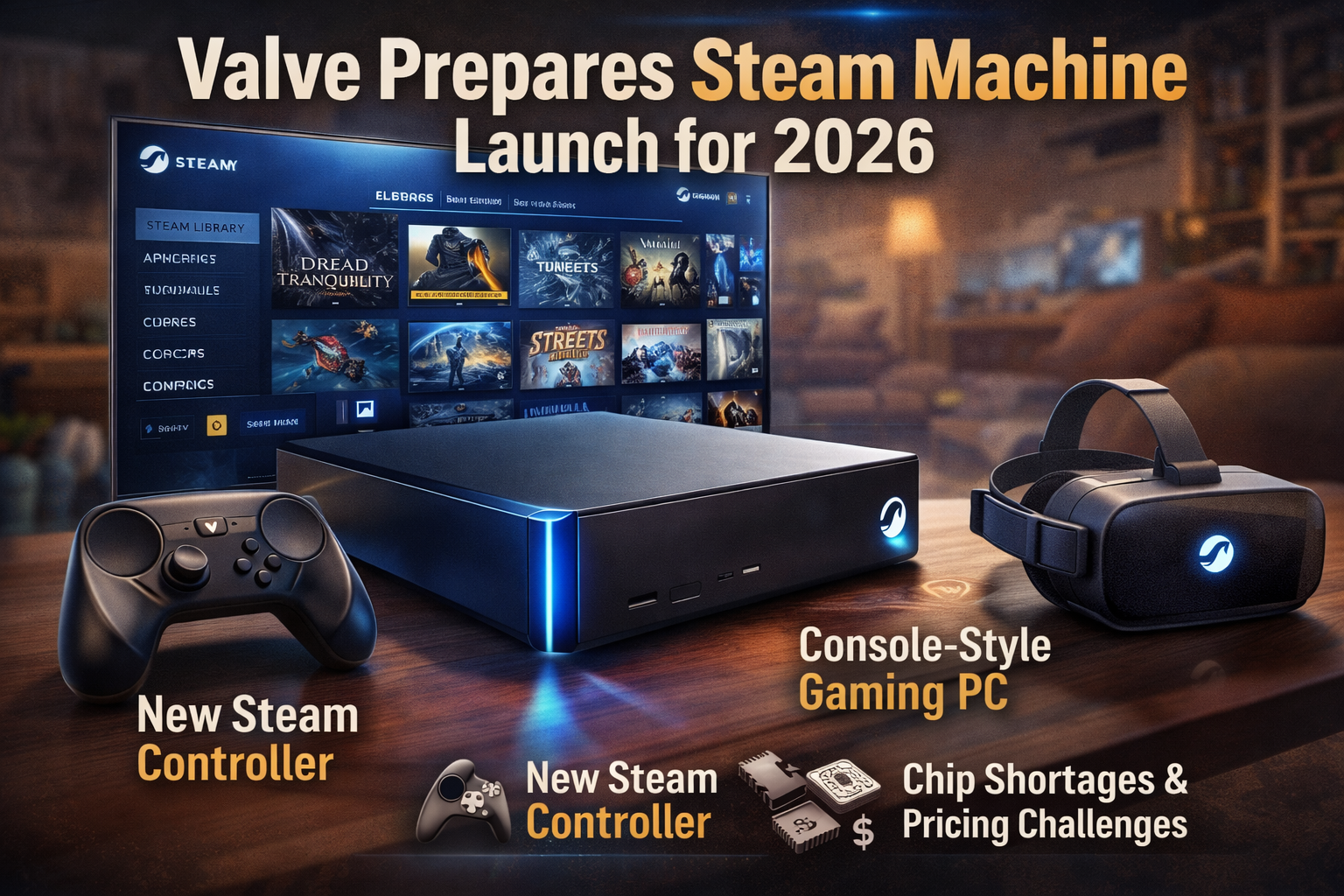
Valve is now teasing its (apparently) fourth generation of the Steam Machine, a console-like gaming PC, to again penetrate the market of living-room gaming hardware, filling the divide between the existing console and the personal computer. The company also affirmed that it is still set to release the device in 2026 together with other hardware products, including a new Steam Controller and a virtual-reality headset called Steam Frame.
The news is an indicator of a new effort on the part of Valve to come up with its own gaming hardware ecosystem. The digital distribution platform of the company, Steam, already has millions of users in the PCs gaming market. With the launch of the new hardware, Valve is aiming to expand its presence into living rooms and provide gamers with a platform that provides the flexibility of the PC gaming experience and the ease of the console gaming experience.
The new line of hardware was first announced by Valve in late 2025, indicating that the items would start shipping in early 2026. Nevertheless, as the company further explained, the timeline may change slightly as the supply chain pressure pushes the global technology industry. Nevertheless, the idea of launching the new Steam Machine in the market in 2026 still remains the objective of the company.
Console-Style PC for the Living Room
The Steam Machine is just a miniature gaming PC that is targeted at television gaming. As compared to the conventional consoles, the device is designed to use SteamOS, which is a Linux-based operating system created by Valve that allows direct access to the giant Steam game library. Valve refers to the system as a cross between a personal computer and a console. The players will be in a position to play games using a simple interface as would be found in the dashboards of a console, but they will also enjoy the freedom of a PC environment. It implies that the users might install more applications, customize the system, or even install other operating systems, such as windows in case they wish.
This is one of the greatest selling features of the Steam Machine idea. Conventional consoles usually enslave players in a closed system, whereas PC-based gaming is far more liberal. Valve envisages a combination of the two worlds that provides a casual experience through the plug-and-play mobile and, at the same time, allows customization to enthusiasts at the same level as a living room. It will work well on contemporary televisions and will be capable of supporting high-resolution gaming performances like the present-day generation consoles.
Hardware Designed for High-End Gaming
The Steam Machine will have a powerful gaming performance under the hood. It is reported that the device will operate on a semi-custom AMD processor, which has the Zen 4 architecture and will have an RDNA 3 graphics card. The components can run games on high settings, and Valve hopes to provide 4K resolution and 60 frames per second in most games. The high-tech solutions like the FidelityFX Super Resolution developed by AMD will assist in enhancing performance as it will rely on the upscaling techniques to ensure that the gameplay remains smooth.
It will also have 16GB of DDR5 RAM and dedicated graphics memory, although storage can be expanded to 512GB to 2TB of fast NVMe SSD, and it will be possible to upgrade certain components, which is not so common on conventional consoles.
New Ecosystem of Steam Hardware
The Steam Machine will not be launched on its own. Valve has an expanded hardware ecosystem in its plans. The company also declared the redesign of the Steam Controller and the newly established VR headset called the Steam Frame, both of which are projected to be released at the same time.
The new controller is supposed to be a step forward compared to the initial Steam Controller that was launched in 2015, which replaced the usual analog sticks with unorthodox trackpads. Although the previous design was controversial among gamers, it allowed Valve to test the new forms of experiencing PC games within a living-room setting.
The Steam Frame VR headset is an indication that Valve remains interested in the field of VR gaming. Valve seems to be creating a related gaming ecosystem just like any other company, such as Sony and Microsoft: by releasing the software operating system alongside the infrastructure hardware itself.
Challenges Facing the 2026 Launch
However, with all these plans, Valve has a number of challenges when it comes to the launch of the Steam Machine. The shortage of important parts like RAM and storage chips is one of the largest problems since it continues to this day. The demand for memory components, especially due to the fast-paced development of artificial intelligence technology, has raised prices throughout the hardware industry.
Such shortages have compelled most of the tech firms to modify their product timetables, and Valve is not an exception. The company had first anticipated launching the Steam Machine at the beginning of the year 2026, but later announced it may be launched in the first half of the year instead.
Pricing is yet another challenge. Contrary to the traditional consoles, which are commonly sold at a loss to lure users in software ecosystems, the Steam machine is simply a PC. This implies that it will most probably be priced to match the price of high-performance hardware parts. The system will be priced way above the price of a normal console, according to the industry analysts, and this may hurt its popularity among normal gamers.
Lessons From the First Steam Machine
This is not Valve’s first attempt at launching a Steam Machine. The company introduced an earlier version of the concept in 2015, partnering with multiple manufacturers to build small gaming PCs that ran SteamOS.However, the original Steam Machines failed to gain traction. Several factors contributed to the failure, including high prices, limited game compatibility on Linux, and competition from established consoles like PlayStation and Xbox.
Since then, the gaming landscape has changed significantly. Valve’s handheld Steam Deck proved that there is strong demand for PC-style gaming devices that provide console-like convenience. The success of the Steam Deck has likely encouraged Valve to revisit the Steam Machine idea with a more refined strategy. Technological improvements have also helped. Proton compatibility software now allows thousands of Windows games to run smoothly on Linux-based SteamOS, removing one of the biggest barriers that affected the original Steam Machines.
Editor’s Perspective: A Risky but Interesting Strategy
From an editorial standpoint, Valve’s decision to revive the Steam Machine is both ambitious and risky. The gaming hardware market is already dominated by powerful ecosystems such as Sony’s PlayStation, Microsoft’s Xbox, and Nintendo’s Switch. Breaking into that space requires not only strong hardware but also a clear value proposition for gamers.
Valve’s advantage lies in its software platform. Steam already hosts one of the largest digital game libraries in the world, and millions of PC players rely on it daily. If Valve can translate that ecosystem into a living-room device that is easy to use, the Steam Machine could appeal to gamers who want PC power without building their own systems. However, price will likely determine its success. If the device launches at a high cost, it may struggle to compete with cheaper consoles that offer similar performance.
Another key factor will be game optimization. Even though many Steam games can run on Linux through Proton, players will expect smooth performance without technical complications.
In many ways, the Steam Machine represents Valve’s attempt to reshape the gaming hardware market. Instead of competing directly with consoles, it aims to create a new category, something between a gaming PC and a console.If Valve succeeds, the Steam Machine could change how people think about PC gaming in the living room. If it fails, it may become another ambitious experiment in the long history of gaming hardware innovation.