
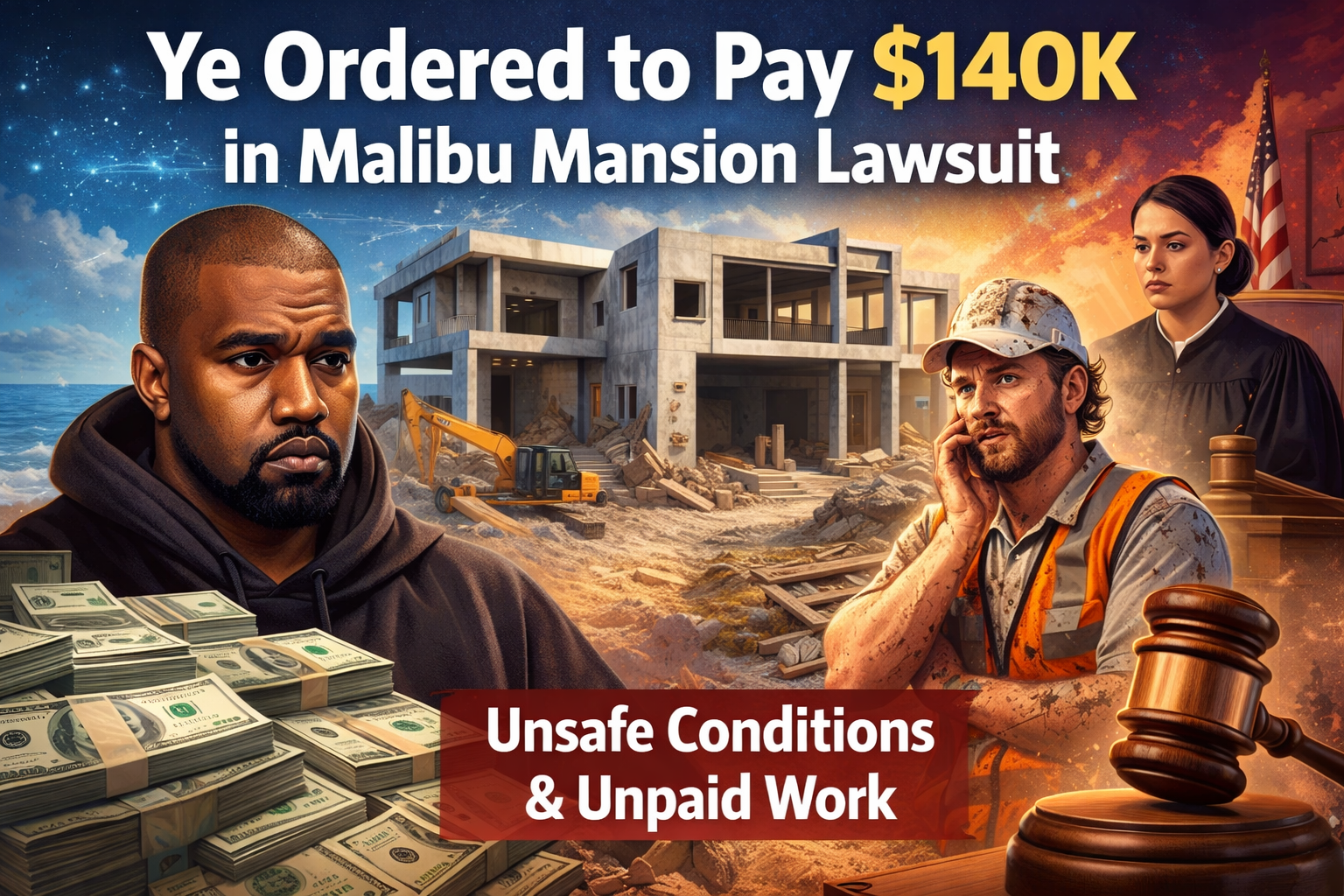
A Los Angeles jury has given a verdict that is at best mixed in a high-profile legal battle between rapper and business mogul Kanye West, now Ye by law. The case involved remodeling of his multimillion-dollar beachfront house in Malibu, California, where a former contractor alleged to have been subjected to unhealthy working conditions, unpaid labor, and termination.
The jury made a finding after weeks of testimony and legal arguments that Ye will have to pay former employee Tony Saxon $140,000 in damages, though half the amount Saxon originally demanded in her suit, which was $1.7 million.
The ruling partially resolves an otherwise controversial case that not only attracted the interest of the general public due to the undoubtedly legal aspects of the case, but also the dramatic change in a well-known architectural estate and the strange conditions under which the case was presented in court.
The Case of a Malibu Dream Home
The source of the conflict is renovation, which has been carried out on the Ye mansion in Malibu, which is an architectural creation of the famous Japanese architect Tadao Ando. In 2021, Ye bought the house at about 57 million and intended to make some radical changes into a minimalist and self-sufficient home.
As stated in court documents, Tony Saxon was employed in the process of the renovation as a project manager, security guard and caretaker of the property. According to Saxon, his duties soon expanded to include demolition, contract managing work, and overseeing construction activity to tremendous overtime hours.
Saxon claimed that he was to be paid a good salary on a weekly basis, but ended up earning little. He alleged that Ye committed the following in his lawsuit, which was filed in 2023:
- Salary delays and working injustice
- Poor working conditions in construction
- Unjust dismissal following safety complaints
- Discrimination against people with disabilities in employment
The case originally sought damages of 1.7 million dollars in terms of compensation for medical bills, wages and emotional distress.
Assertions of Unsafe Work Environment
At the core of the case were the claims that the renovation site was made unsafe as the construction went on.
Saxon is a witness who testified that the house had been largely gutted during a bid by Ye to restructure the house. Sometimes, he alleged, the mansion was devoid of plumbing, electricity, windows, and other fundamental infrastructure, and the workers had to work in the conditions that he presented as hazardous and disorderly.
He further alleged that he had to put up at the location, on the ground, occasionally using his coat as a bed, and served as a 24-hour security guard to the building project.
In the trial, lawyers of Saxon claimed that such conditions were against labor protection and were negligent on the part of the landowner.
Ye’s Defense in Court
The legal team of Ye responded to the assertions, saying that Saxon was not a full-time employee but an independent contractor with no license. By the California law, they said, they could not assert any unpaid wages by Saxon because of such a classification.
The defense further denied the degree of injuries suffered by Saxon and the sum of money he was alleging to be owed. Ye’s attorneys claimed that Saxon had already paid a lot and lied about the events around the dispute.
Ye himself appeared as a witness in the trial. Courtroom reports indicated that he had a very short and sometimes vague testimony, and the musician repeatedly stated that he could not recall specifics of the employment of Saxon or the exact terms of the working contract.
Onlookers have remarked that Ye seemed detached at one stage when being questioned, at moments even shutting his eyes when prosecutors were making their case.
The Jury’s Decision
Upon consultations, jurors gave a divided verdict. They determined that Ye was liable on some of the claims involving the injuries and losses suffered by Saxon but denied most of the damages demanded.
The jury also awarded Saxon $140,000 to pay the medical bills and wages instead of the $1.7 million as requested.
The court ruled lacked punitive damages, although experts in the field of law assert that Ye might potentially be required to pay hefty legal expenses that may well exceed the amount of the initial award.
The result was characterized by the attorneys of Saxon as a win for their client, and the case was a David vs. Goliath fight against a celeb with great wealth.
Mansion in the Middle of the Scandals
The Malibu house in itself is nearly a household name, as is the lawsuit that surrounds the house.
The oceanfront house was initially a minimalist masterpiece by a building engineer known as Tadao Ando, which caught the eyes of the world when Ye bought the house. Yet the ambitious renovation schemes of the artist have allegedly left the building as a bare concrete structure.
Once, Ye considered converting the property into an off-grid bunker-like home, alternative energy sources and complete radical design transformations.
The project did not make it to completion. Ye later sold the premises at an approximate price of 21million dollars, which is a huge loss to the price at which it was bought.
Legal Battles May Continue
The case might not be resolved entirely even with the verdict.
Ye has already submitted an independent case to do with a mechanic lien that Saxon and his attorneys had placed on the property, claiming that it is part of a larger series of actions to squeeze him financially.
This case is still under review, which means that both parties still may have other courtroom disputes in the months to come.
Editorial View: A Case Study of the Celebrity Construction Mayhem
Regarding the newsroom standpoint, the case of the Malibu mansion lawsuit is not simply a contractor fight- this is a pattern that is emerging in the celebrity real estate projects.
In the cases where high-profile owners are trying to realize radical design visions, a construction project may turn into a disorganized ecosystem with dozens of contractors, subcontractors, and consultants. Lack of a defined management system is likely to result in confusion of the safety, payment, and legal compliance responsibilities.
The trial in this instance demonstrated the clash between the realities of the construction law and ambitious design experimentation. The conversion of a masterpiece in architecture to a half-built ruin was to symbolize that conflict between imaginative potential and functional rigor.
In the case of Ye, the settlement can be economically viable to his overall business conglomerate. However, the case gives the artist another chapter in a long series of public scandals, reputationally.
To employees and subcontractors, the result also sends a message: although they encounter large employers, the courts are not the place where labor conflicts can be addressed, and sometimes, even adjudicated in their favor.