
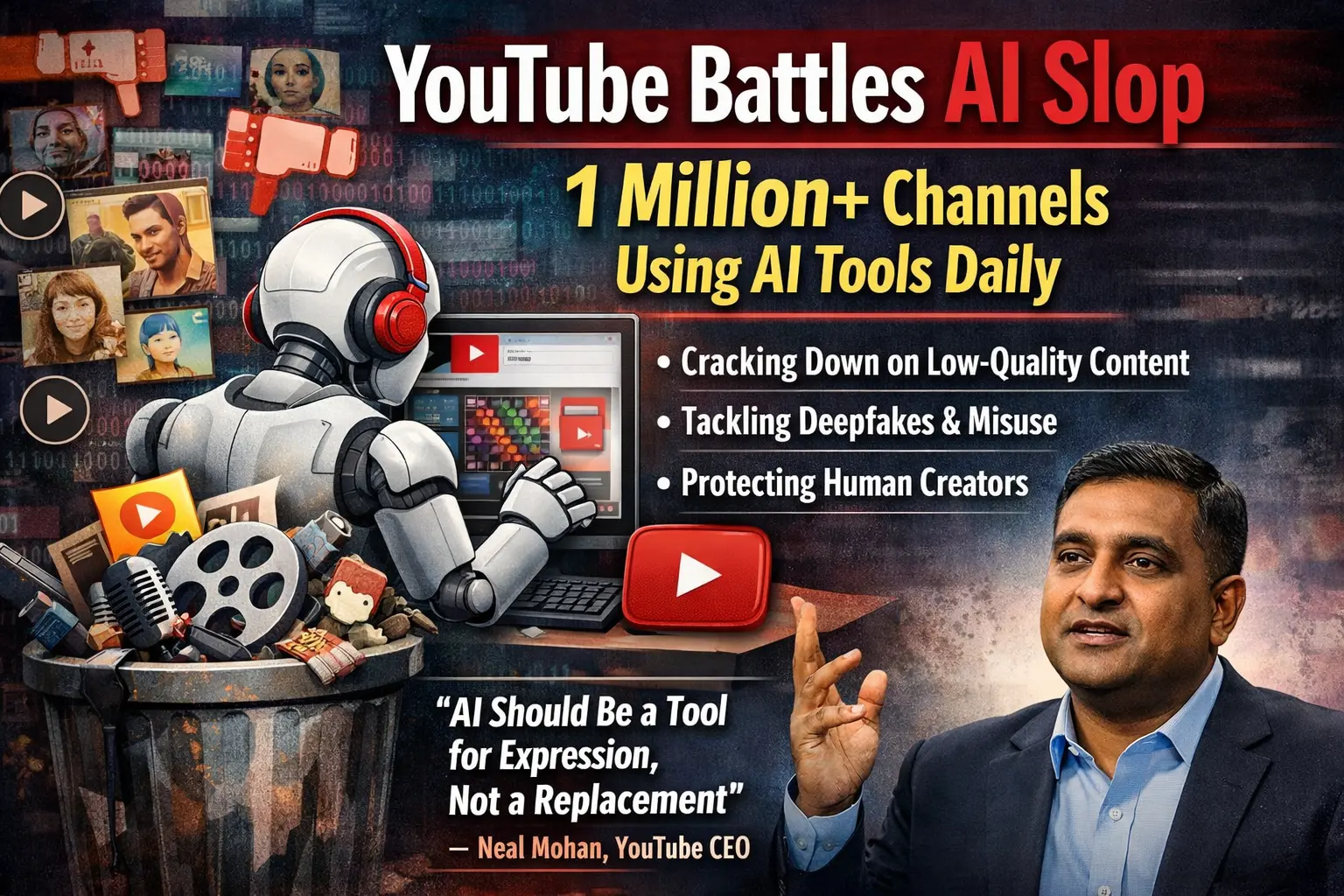
YouTube is going through a phase of its development when artificial intelligence changes how video content is produced, viewed, and controlled on the largest video platform in the world. In an annual letter widely published, the CEO Neal Mohan wrote that more than 1 million YouTube channels were daily using the company tools to generate AI creation in December 2025, highlighting the extent to which AI has already been incorporated into the creator ecosystem.
It is this milestone that will mark the dual reality of the platform in 2026: AI is both a potent creative instrument and something that makes more and more people worried.
AI Tools: Everywhere and Everywhere, but Problematic.
The AI development at YouTube has helped creators automate a lot of production processes. The tools include both basic tools such as an AI-generated title and a thumbnail, as well as more sophisticated tools such as autodubbing, music creation with the help of AI, text-prompt games, or even the creation of Shorts inspired by the digital image of a creator.
These technologies are meant to assist creators to reach wider audiences and generate different content more effectively. In the case of smaller channels, AI capability may prove to be radical – making tools that once needed big budgets and special expertise available to everyone.
But it is the same democratization that is debatable. As more creators have the ability to make videos on a large scale, a big share of the content quality on the platform is now dependent on how the tools are employed.
Problem Development: What Is AI Slop?
The term highlighted in Mohan letter has caused debates throughout the tech community: AI slop. This is seen as poor quality, monotonous or computer-generated content which has minimal value to the viewer.
It has come to be a colloquialism to refer to the deluge of AI-generated content that is choking feeds, degrading discovery architectures, and poses a danger of deceiving consumers. It is not merely low production values but the real problem is that not all AI videos are creative, original, or substantive, which is why they are bemoaned as slop.
AI slop is not an imaginary concern. A separate study conducted in January revealed that over 20 percent of videos presented to new visitors contained AI-generated content of dubious quality, and some channels have racked up huge numbers of views with little in the way of actual value.
It is a tendency that has attracted attention of advertisers, long time creators, even algorithm engineers. Engagement and trust might decrease once users are exposed to more and more repetitive or unrelated content this may pose a risk to the very existence of YouTube as a company.
Strategy of YouTube: Controlling innovation without choking innovations.
Mohan clarified that fighting AI slop is one of the priorities in 2026. According to him, YouTube will also apply the systems that have worked in eliminating spam and clickbait to eliminate low-quality AI material.
The main aspects of the strategy are:
Octogenic AI images and videos to be better tracked and labeled to enhance transparency.
Better automated and human-aided moderation systems to limit repetitive or low-value content.
Deepfake safeguards and likeness controls in a way that the creators can challenge the use of their faces or voices without their permission.
Encouragement of such laws as the NO FAKES Act to combat hazardous synthetic media.
These are all efforts in a bigger push to make sure that AI complements YouTube and not to the extent to eliminate the human creativity that goes into the best content. Mohan stressed that AI is not to be used as a replacement but as a means of expression.
Monetization in an AI Era and Creator Economy.
Content policing is not the only part of the AI story on YouTube. Mohan also detailed expansion plans of monetization tools and creator support system. These are such aspects as in-app purchases and the facilitation of brand deals, as well as other sources of revenue beyond split of ads.
This makes sense: as AI reduces the barriers to content production, YouTube needs to provide creators with valuable means of making a sustainable income. Unless there is strong monetization, quality creators may walk away on the platform, or even worse, they might create more of the exact AI images that YouTube seeks to restrict.
Striking a Balance between Innovation and Trust.
In a more general sense, YouTube is trying to tread a thin line that a significant number of technology platforms are challenged to walk nowadays: it has to be innovative and at the same time offer protection to the user experience.
On the one hand, AI will make the production of content more affordable and stimulate experimentation. Alternatively, AI uncontrollable spread can also cause a reduction in the signal-to noise ratio on the platform, which YouTube recommendation algorithm has been unable to achieve in the past.
The AI era has posed a quality dilemma of human machines unlike the previous stages where the ability to engage was only done through algorithmic adjustments. The reaction of YouTube to this issue through moderation, transparency and support to creators is an indication that the company is aware that AI cannot be left unmonitored without it destroying the long-term value of the platform.
My Verdict: It was a Tipping Point in YouTube.
Being an old-time editor who is observing this space, I consider this to be a decisive moment in the coming decade of YouTube. AI is no longer a side show or a niche feature, but it is integrated into the daily creation and consumption patterns. The problem is now no longer how to regulate bad material, but what good material should actually appear to be in an AI-enhanced world.
The course of action of YouTube must include:
More straightforward rules that can be used to differentiate between AI-assisted productivity and filler content.
Increased transparency to the viewer regarding the AI-generated.
Moderated but not inquisitive tolerance.
In case YouTube is successful, it would set an example of how big platforms can adopt AI in a responsible manner. Should it stumble, the platform could be subjected to a gradual loss of confidence in its favor of rivals.
To a great extent, 2026 is not only about creating more useful AI tools but also about strengthening the culture and creative conventions that have so far made YouTube an essential part of life.